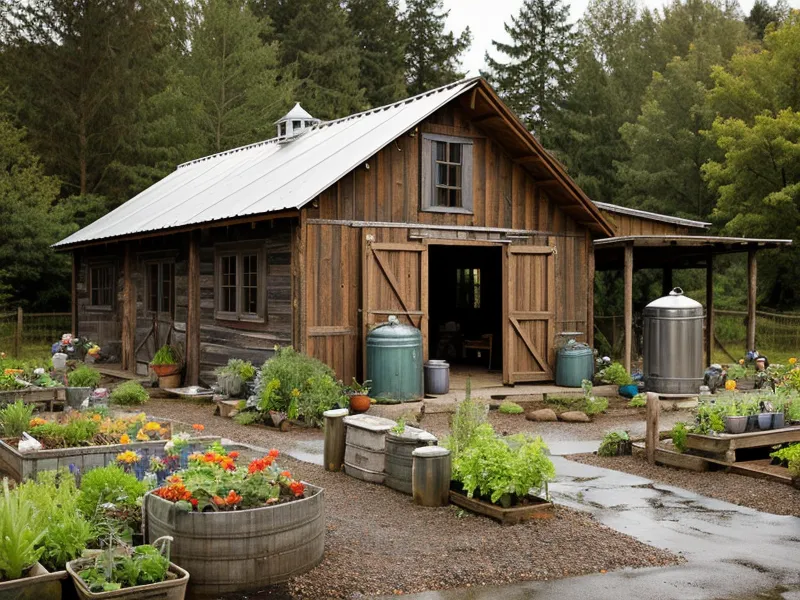
One wet afternoon last autumn, I stood by the chicken coop watching gallons of water sheet off the metal roof and dive straight into the mud. I was soaked, my boots were sinking into the Oregon clay, and all I could think about were my parched tomatoes from the previous July. I could still hear the ghost of that terrifying, hollow sound our well pump made when it ran dry during our first summer here. It’s a sound that haunts your sleep when you move from a Portland apartment to five acres of dirt and responsibility.
Standing there in the rain, I realized I was literally watching my summer insurance policy drain into the ground. I’m not an engineer—I can barely use a tape measure without getting a thumb-cramp—but even I could do the math. If I could catch that water, I wouldn't have to spend all July hovering over the pressure gauge, praying the aquifer was keeping up with my thirstiest zucchini. It was time to stop being the clueless city person and start figuring out how to catch the sky.
The Trauma of a Dry Well
If you’ve never lived on a well, let me tell you: water is no longer a utility. It’s a relationship. When we moved here three years ago, we treated the tap like we always had. We took long showers, ran the laundry whenever we felt like it, and watered the garden like it was a public park. Then came that first August. The pump sputtered, the pipes groaned, and suddenly we were hauling jugs of water from a neighbor’s house just to flush the toilet. There is no landlord to call out here. There’s just you, your partner, and two very confused dogs.
That memory was the main driver when I started scouring local listings in late October. I was looking for IBC totes—those giant, square plastic cages you see on the back of flatbed trucks. They are the gold standard for people like us because they hold a massive amount of water without costing a fortune. A standard IBC tote has a capacity of 275 gallons. When you’re used to a 50-gallon rain barrel, 275 feels like an ocean. I managed to find two food-grade ones for about a hundred bucks each from a guy who smelled faintly of peppermint oil.
I’m not a structural expert—and you should definitely talk to a professional if you’re worried about your building’s integrity—but I knew one thing for sure: water is heavy. A full 275-gallon IBC tote weighs approximately 2,300 pounds. That’s more than a subcompact car. If I just plopped that on the mud, it would sink halfway to China by December.
The Muddy Reality of the Build
One grey Saturday in January, while the rest of the world was probably watching football or drinking lattes, my partner and I were wrestling concrete blocks into the frozen ground. The goal was to build a platform high enough that gravity would do the work for us. No pumps, no electricity—just the weight of the water pushing through a hose. This sounds simple in theory. In practice, it involved me shouting at a level while my partner tried to shimmy a heavy block into place with a crowbar.
We used 3-inch PVC schedule 40 pipe for the diversion. That’s the heavy-duty white plumbing pipe you see at the big-box stores. Why three inches? Because when it pours in Oregon, it really pours. If your pipe is too small, the water just backs up and overflows your gutters anyway. I’ll be honest: our plan involved more zip ties than any building code would likely allow. I used them to secure the mesh screens (to keep the drowned bees and cedar needles out) and to steady the downspouts. Zip ties are the unofficial mascot of my homestead.
I hit my first real 'I want to go back to the city' moment when I was connecting the main diverter to the tank. I was so excited to finish that I rushed the cut on the pipe. The cold realization hit me when the first connector leaked, soaking my boots through in seconds because I forgot to deburr the pipe—that's just a fancy way of saying I didn't sand down the rough plastic edges after cutting it. I stood there, dripping wet, holding a useless piece of plastic, while the chickens stood in their coop and watched me with what I’m certain was judgment. They know I’m faking it.
The Storm That Proved It Works
After about three weeks of tinkering and re-tightening every connection, a massive mid-winter storm rolled through. It was one of those nights where the wind rattles the window frames and you just want to huddle under a blanket. But I couldn't stay away from the window. I kept clicking on the porch light to look out at the garden.
I could hear the rhythmic thwack-slap of heavy rain hitting the hollow plastic tote. It’s a specific sound—a drumbeat of progress. As the night went on, the pitch changed from a hollow 'thwack' to a solid 'thud' as the water level rose. It was incredible to see. If you have a 1,000 square foot roof, you can collect about 600 gallons of water for every single inch of rain that falls. Our little chicken coop isn't that big, but even that modest roof was filling the tote with shocking speed. By the next morning, we had 275 gallons of 'free' water sitting there, ready for July.
It was a turning point for my anxiety. For the first time since we moved here, I didn't see the rain as a nuisance that made the driveway muddy. I saw it as a bank account being topped off.
The Secret Sauce: Why I Don’t Filter My Garden Water
When you start researching rainwater harvesting, you’ll see a lot of people talking about multi-stage filtration, UV light sterilizers, and charcoal filters. If you were drinking this water, absolutely—do all of that. But for my vegetable garden? I don't bother with anything more than a basic debris screen. In fact, I’ve started to realize that the 'raw' nature of this water is actually a benefit.
Most city water is treated with chlorine or chloramine to kill bacteria. That’s great for pipes, but not always great for the delicate microbiome of your soil. Rainwater is naturally aerated as it falls, and it picks up trace amounts of minerals and organic matter along the way. I’ve noticed that my plants actually seem to have a growth spurt after being watered with the rain system compared to when I used the well water. The biological life in raw, aerated rainwater actually accelerates nutrient uptake in vegetable garden soil. It’s like giving your tomatoes a probiotic smoothie instead of a glass of tap water.
Of course, this means the water in the tank isn't crystal clear. It has a bit of a 'pond' smell if it sits too long, which is why I’ve learned to be diligent about maintenance. If you're curious about the unglamorous side of keeping these tanks clean, I wrote about the 6-hour scrub I have to do every year to keep the algae from taking over. It’s messy, but it’s part of the deal.
Living Without a Landlord
Walking through the garden this mid-April, I felt a sense of peace I haven't had in years. The starts are in the ground—peas, kale, and the first of the brassicas—and I can water them without that low-level hum of anxiety about our aquifer. I’m not saying my system is a masterpiece. There are still parts of it held together with stubbornness and a few extra-long zip ties I bought at the farm store. But it works.
There is something deeply satisfying about being the one who figured it out. When the power goes out or the well acts up, I know exactly where my water is coming from. I’m not an engineer, and I’m definitely still that person who forgets to deburr a pipe now and then, but I’m learning. Out here, you have to. There’s no one else to call, and honestly? I think I prefer it that way. Even the chickens seem to have stopped judging me. Mostly.
If you're just starting out on your own property, don't feel like you need a Pinterest-perfect setup on day one. Start with one tote, a few concrete blocks, and a willingness to get your boots muddy. You’ll make mistakes—you’ll probably get soaked—but when that first summer heatwave hits and you have hundreds of gallons of rainwater ready to go, you’ll be so glad you didn't wait for a professional to do it for you.